Teach Like a Champion and Positive Framing

My summer professional development included two book studies. My favorite book out of the two was definitely Teach Like a Champion by Doug Lemov. The book contains techniques that master teachers use on a daily basis to help students succeed. Each technique is broken down into a key idea, rules/methods, and examples. The book not only details the steps for each technique, but it also includes a DVD that shows video of master teachers modeling them in a real classroom. It is a book that you can read in little pieces, something that I really appreciate being a mom.

As I was reading the book, I kept on seeing things that I do without thinking. I realized that the ways I reacted were not the most conducive to encouraging student achievement. The techniques given were fixes that were logical. In fact, Lemov’s suggestions are easy and, if done consistently, become good habits. 
One of the techniques that really stood out to me was number 43 called “Positive Framing.” The key idea behind Positive Framing is: “Make corrections consistently and positively. Narrate the world you want your students to see even while you are relentlessly improving it” (p. 205). The essence of this technique is to live in the now and be positive about what you are asking the students to do. It does not mean that you only talk about the positive things that students do. It means that you focus on interventions for behavior, but you do so in a positive manner. You have the expectation that students will behave a certain way and you use reminders instead of guilt/punishment to maintain the direction that you want the class to go in.

I was really struck by the rule “assume the best” (p. 205). According to Lemov, it is important to not “attribute to ill intention what could be the result of lack of distraction, lack of practice, or genuine misunderstanding.” Now, I feel that I am positive when it comes to my classroom manner. My students enjoy my class and generally feel good about themselves when they leave. However, when I ask my students to do something, I realize that I often frame it negatively.

Lemov, D (2010). Teach like a champion: 49 
techniques that put students on the path to 
college. San Francisco: Jossey-Bass. (p. 109)

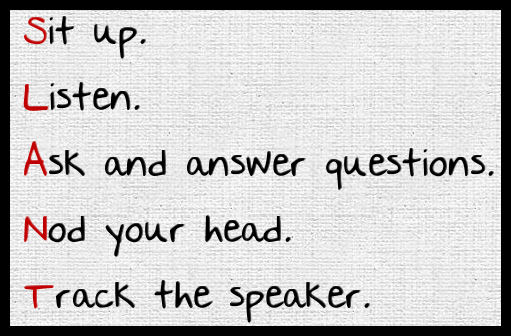
For example, when I have a student that isn’t on task, I sometimes say,  “If you don’t get on task, I am going to have to start requiring you to stay after school to make up time.” Lemov points out that, by stating it this way, I am assuming that the student will not stay on task. The solution is to say “Show me your best SLANT” and walk away “as if you couldn’t imagine a world in which (the student) wouldn’t do it” (p. 206). Of course, you may have to go back a couple of times to make sure that the student knows exactly what is expected, but it tells the student EXACTLY what you want him or her to do.

Imagine what it would be like if you started this at the beginning of the year? Off-task behavior would still be there, of course, but I bet it would be much easier to get the whole class back on track if you reacted positively by stating high expectations and standards. The entire book is like that. I kept on having “aha” moments as I worked through it. If are looking for a book that will improve your classroom management almost instantaneously, this is definitely a book to check out!

__________________________________________
Have you read a book this summer that really made you think? Leave me a comment because I’d love to check it out!

Philly "Phirsts"

Okay… I know that was a bad joke, but it made me giggle.

My district sent me to the ISTE (International Society for Technology in Education) Conference in Philadelphia. I was one of the lucky ones that got chosen. I was very excited to go. What I didn’t realize at the time that I was chosen is the fact that this trip would change my perceptions of so many things.

First off, Philadelphia is an awe-inspiring city. I didn’t realize how much history and diversity is packed in the small area where we were. We stayed at the DoubleTree on Broad Street. It is a gorgeous facility with a lobby that is great for people watching and hanging out. The best thing about it is that it was within walking distance of so much. I took advantage of it as much as I could.

Here are some of my firsts in Philadelphia:

I had my first Philly Cheesesteak at Spatoro’s in Reading Terminal Market. Let me tell you, the experience was definitely an interesting one. I waited in line for 45 minutes for the steaky-cheesy-oniony-peppery deliciousnes. Believe me, it was worth the wait. I now have a baseline for what a good Cheesesteak tastes like.

The buildings had murals on them!

I had my first ride in a taxi. It may sound corny, but it was something that I’ve always wanted to do. Luckily, I was with a very city-savvy young lady who made sure I didn’t die (thanks, Tracy).

I walked around a big city by myself. Previously, I wouldn’t be caught dead by myself in a place the size of Philadelphia. Here is the back story: My travel companions didn’t want to go to a gift shop that I wanted to enter. Instead of just passing it by, I told them that they could go ahead without me. It was a phenomenal feeling not having the pure anxiety that I used to have when walking alone. By the end of the trip, I was completely comfortable with being on my own.

Broad Street

I talked to people I didn’t know at all. In fact, I made first contact. Usually I sit back, observing everyone, thinking things in my head that I want to say aloud, and keeping silent. I pushed myself out there and struck up conversations with complete strangers. I decided that this ISTE conference would be one where I focused on my networking skills. It was very enriching. I think I get why people do it now. I am still not 100% comfortable with it, but I’m closer.

I took my alone time when I needed it. I am not good at taking myself out of a situation or a group because I don’t want people to think that I am not social. I’ve come to realize that I need my solitude in order to process. If I don’t get this, I go into a sort of a panic mode. By giving myself permission to go be by myself without feeling guilty, I was able to avoid some of the troubles that I usually have when dealing with large groups. It also helped that the great group of people I am with didn’t take it personally when I didn’t hang out with them.

Overall, the ISTE conference really enriched my life, both personally and professionally. I am so very thankful for the opportunity. I think I am going to have to figure out how I can attend next year’s conference in San Diego!

7 Ways to Increase Comprehension in Struggling Readers

If you have never had an opportunity to go to one of Dr. Archer’s conferences and you are even remotely interested in literacy, you need to figure out a way to go to one. Beg your administrators, save up your change, have multiple yard sales, ANYTHING to help you make it. Dr. Archer is charismatic, entertaining, and generous. To top it all off, the strategies that she presents are research-based as well as practical. She focuses so much on active participation that it is easy to see why her methods are so effective.

My top 7 Take-Aways from the Conference

1. Don’t commit assum-icide. Sometimes we, as teachers, forget that our students don’t come pre-packaged with the information that want them to know. Because we assume, we generate gaps in our students’ knowledge. These gaps interfere with comprehension to a great extent. It seems logical, but I know that I have been guilty of assum-icide.

2. One of the best things you can do for struggling students is to *teach* them. I know this seems like a no-brainer, but, if you really think about it, how much time to do we actually get to do this? It is the explicit instruction that really helps the struggling readers. Discovery learning definitely has its place, but if the students have no knowledge base, there is little chance that they are going to discover on their own.

3. Teaching reading should not just happen in the Language Arts and English classes. Every subject area has an incredible opportunity to teach reading strategies to help their students become fluent readers. Content area teachers need to get out there and share information with their students while teaching them HOW to read it. 

4. Without automaticity, comprehension is inhibited. With fluency comes comprehension. If a student’s cognitive energy is being put into decoding, there is no energy left for comprehension. It is essential to give students the skills they need in order to be fluent readers. 

5. Practice, practice, practice. I know that I am very good at initial instruction. I can get my kids rip-roaring ready to go. The units that we work on are (usually) successful, and the students demonstrate mastery at the end. Dr. Archer asked us what would happen if we tested our students two units down the road. Would they demonstrate the same amount of mastery?I realized that my students might not. Practice is key. Working in cumulative review into my lessons will help prevent my students from losing what they’ve  learned.

6. Teach vocabulary explicitly. Pick the words that you want your students to really own. They need to be unknown words, abstract in nature, and applicable. Boutique words (words that students will never see in their real lives) aren’t ones that should be focused on. This made me think of the short story “The Gift of the Magi,” by O. Henry. One of the vocabulary words that the teacher edition suggested for explicit instruction was mendency squad. Would that be a vocabulary word that is worth spending the time teaching? I am going to start asking myself that question more often, now.

7. Get an English Language Learner dictionary. These dictionaries give student friendly definitions. When you teach vocabulary, you need to provide your students with definitions that they can understand. Anyone who has checked out a dictionary lately probably has noticed that the definitions aren’t readily accessible to your average adolescent reader. The definitions in these dictionaries take the work out of creating denotations that are understandable.


Final Thoughts
There was so much more that I learned from the conference. The three days were not in vain. I just know that I am excited to see how the new practices and procedures increase the success of my struggling readers. For those of you who have heard Dr. Archer, I have one final thought. Woo-woo. 🙂

8 Big Ideas

I was recently turned on to this post by Scott McLeod (thanks to Twitter). Mr. McLeod writes about the GenYes Blog’s post about the 8 Big Ideas of the Constructionist Learning Lab. As I was perusing the “8 Big Ideas”, I started thinking about what goes on in my classroom. The ideas outlined seem like no-brainers, but I had to ask myself if I followed the concepts presented. After all, part of being a life-long learning is reflection, correct? The process was very eye-opening to me.

I realized that I still need to work hard on learning by doing. Trying to figure out how to make reading and writing a hands on activity is something that I struggle with. One of the ways that I am going to try to address this is by having my students be more hand on with their learning. I am going to go over the standard with them (thank you, Common Core Standards, for allowing me to do this without my brain exploding) and then ask THEM what they need to know in order to master the standard. I know that it will make planning more extensive, but the benefits will greatly outweigh the costs.

This segues perfectly into the next idea that struck me as pertinent: learning to learn. By giving my students more control over their learning, I will be giving them skills that will help them for the rest of their lives. Maybe it will encourage them to take the next step and the next and eventually not be so reliant upon other people to give them information. I also know that it is going to be a long process to get my students where they need to be. Many of them will be frustrated and challenged more than they’ve been challenged before. However, once they get started, they will enjoy it.

Hard fun is the third concept that stood out to me. Once they get used to the difficulty of guiding their own learning, they will start to see the fun in it. When I think of the classrooms of teachers that I admire, I see the students working hard, but having fun. The teachers in those classrooms take a challenging, abstract idea and make it the students’ responsibility to make it concrete. They guide the students, of course, and give them the help that they need when they get stuck; they also allow the students to fail over and over again in search of the solution. The thing is, the students love it. I like to think that I give my students some opportunities like this. I also know that I could do so much better at providing these sorts of things for my students.

Big idea #5, taking time, is one that worries me the most. I know that I can give my students unplanned time in the classroom. In fact, I do it often. When I say unplanned, I don’t mean letting the students do whatever they want. I mean that they have a task to complete in a certain amount of time, but how they get there is up to them. Unfortunately, my ability to give my kiddos time to learn how to manage it is limited by the requirements of the district. In this time of benchmarking, testing, assessing the assessments, and high stakes testing, the timeline of my classroom is determined by my administrators. Instead of being allowed to go more in-depth with what my students are learning, I have to fit 20 performance objectives into four-week intervals. I have to figure out a way to help my students get to where they need to be while still passing the “formative” pencil-and-paper tests required by the district. Maybe giving them the skills to learn on their own will help.

This is only the beginning of my musings on this topic. I know that I will have many more epiphanies as my brain chews on these concepts.

Burdens and Blessings

Today I realized yet again how important my job as a teacher is. Three students showed their trust in me by sharing their precious secrets, fears, and interests. Each of these children came to me and shared in their own special ways that I treasure.

The First Student
One of my students opened up to me about a traumatic experience that she had. She and her mother were driving when a person on a small moped lost control of it and swerved in front of their car. She watched this person hit the windshield right in front of her and roll off the front of the car. Unfortunately, her mother was not able to stop in time. The person died.

This little girl was non-functioning. She was walking around, completely numb. When I asked her if she was okay, she burst into tears. She told me that she couldn’t stop thinking about it, that it kept replaying over and over in her head. Through her sobs, she kept on saying, “But Miss, he was wearing a helmet; he was wearing a helmet.” My heart is breaking for her right now. I can’t even imagine what she is going through. This is a child that I am sending my heart out to. I feel powerless, but I did every thing I knew to do in order to help her.

The Second Student
My second student is a stoic sophomore who has seen it all and is tougher than everything, just ask him. He is struggling in my class, as well as his others. It is not because he isn’t capable of doing the work– something he readily admits; he just doesn’t care (his words, not mine). He says to me that he heard that junior year is the hardest year of high school. As we talked about his future he revealed that he used to be on the honor roll, a straight A student.

I asked him if he knew why he changed. He said he knew exactly what the problem was. He got mixed with the wrong crowd and started doing things he should not do. Now he is stuck in the culture and is trying to get out of it. His parents know of this and are doing everything that they can to help him. His eyes welled with tears as he talked to me about how he knows he needs to get out of it and that it is so hard, but he is trying. He opened up to me about this, allowing his vulnerability to show. I know that it was so hard for him to share this with me. I was honored to know that he felt safe and secure enough to seek my encouragement/advice about it. I told him so.

The Third Student
This story is completely different from my other ones. I have a student who is on the spectrum and struggles sometimes in class. He is brilliant but socially awkward. Well, when I think of it, what freshman isn’t a little socially awkward? This young man has two things that he fixates on: reading (it soothes him when he needs it) and movies. You tie those two things together and he is in heaven.

Through the year, we have been working very hard to build a relationship. Today, I realize that we made it. He came up to me, out of breath, asking me if I’ve ever read The Great Gatsby. When I answered in the affirmative, he started gushing about the fact that they are making a movie of it, directed by Baz Luhrman (the same one who did Romeo and Juliet with Leo DiCaprio and Claire Danes). This was IMPORTANT to him. He shared it with me throughout the hour (even when he was supposed to be working on his assignments). I just let him, happy in the fact that he was sharing something with me that he valued. Plus, I can’t wait to see the movie. His enthusiasm has got me interested.

The Gift of a Teacher
The gift of touching so many young lives can be overwhelming. Knowing that I was a safe place for these young adults to come and share really means something to me. It also has left me emotionally drained and torn up inside. My heart aches for the first two. Actually, aches is not even a strong enough word. I am heartsick. When I think of the trauma and struggles that they have gone through already at such a young age… I don’t even have words. However, I know that this will help them to become even stronger adults. Knowing that I had a part in comforting them makes me feel like I am answering a higher calling, that my purpose in life is beyond my comprehension. It is both a burden and a blessing. I wouldn’t have it any other way.

On Friends and Books

One of my cherished friends gave me a book yesterday. To me, the gift of a book is one of the most caring of all. It requires knowledge of the person you are giving it to. After all, you don’t want to give them something that they would not be interested in. Giving a book is showing someone that you know them and care for them.

My friend knows me. She accepts me for who I am– my good days, my cranky days, my ocd days. It is so nice to not feel judged and not feel the need to conform to what I think she wants me to be. She is my OCD checker, my enthusiastic encourager, my positive sympathizer. She lives life large and has taught me that it is useless trying to be anyone but yourself. I’m still learning that one!

The book that she gave me is called cold tangerines by Shauna Niequist. I started reading it yesterday and got through the first essay called “on waiting.” I could have written it. Okay, maybe not exactly the way she did, but still. She talks about the movies that have the “Big Moment”. You know, the moment when everything comes together and changes the characters’ lives forever. Niequist writes, “I cry and cry at these movies, because I am still waiting for my own big moment. I had visions of life as an adventure, a thing to be celebrated and experienced, but all I was doing was going to work and coming home, and that wasn’t what it looked like in the movies” (p. 16). It hit me that this is how I’ve seen life and I’ve felt a little bit like a failure because my life was not “interesting” enough to matter.

Well, to that I say HA! I am going to take my little moments that make up my life and use them to have the best life I can. My life is not boring. It is my life and I enjoy it, for the most part. Thank you, my friend, for giving this book to me. I can’t wait to see what other insights I glean from reading it.

Reasons for Tattoos

Today I am suffering a little bit from misanthropy. Maybe it is the fact that I am getting a little bit tired of having so many people around. Maybe I am just cranky. Who knows, but it is what it is.

Knowing this, I went to the grocery store at a time when I thought it would be less populated in order to pick up some corned beef. I was wrong. There were so many people there it was overwhelming. After being crushed, rushed, and cut off, I decided that there was not enough yumminess in corned beef to deal with it. I left empty handed.

On the way home, I texted my husband about my frustration and made an offhand comment about wanting another tattoo. His response was one of incredulity. “You mean, you want to get a tattoo because the people in Fry’s pissed you off?” It made me laugh– which helped to alleviate some of my frustration. Not enough to send me back in to the store to get corned beef, but still lifted my spirits.

Then I got to thinking about all of the reasons people have when they get a tattoo. Some do it out of boredom. Some out of a need for the rush from the pain. Others do it because they are highly intoxicated. This, of course, led me to introspection. I got my first tattoo to celebrate my anniversary and the great things that had come to my life. My second one was to remind me to keep faith and to try not to harm others with my behavior. Finally, my last one was a present to my hubby– the man who makes my life livable. I can tell the story behind each of my tattoos.

The story behind each one is essential. I just keep thinking, though, that it would be amusing to say to someone: “Well, I got it because I hated people that day.” It would be interesting to see the looks on their faces!

Life Interferes Again

Is blogging to yourself the same thing as talking to yourself? It makes me wonder sometimes. Anyway, I am back again. I know that all of my followers (ha ha) have missed me while I was gone. A little bit to catch up on what has been going on:

  • My darling daughter’s broken leg healed perfectly. She didn’t need any physical therapy or anything like that. Yay! I didn’t realize how expensive a broken leg is, though. We are still trying to get out of that hole. It is going well, though. 🙂
  • I never did finish Moby Dick. I decided that life was waaaaaay too short to read a book that bored me to tears.
  • I took a class about technology standards in education by the AZ Department of Education. It was lots of work but massive amounts of fun. Plus, I learned so much. I was complimented when the facilitator recommended me to facilitate one of the next waves of courses. Unfortunately, I was unable to apply for it. Too bad, though. It would have been fun!

    That is the catch up portion of today’s post. Now on to other things.

    Part of one of the classes that I am taking has to do with integrating blogging into my classroom. I think that it would be a really interesting thing to do, but I wonder if I would be able to keep up with it. I have to figure out a direction for this blog. I think that is one of the reasons why I have been deficient in posting.

    There are so many blogs that I have seen that I really, really like. I have discovered Neil Gaiman‘s blog and have thoroughly loved reading his words. Of course, I couldn’t read his blog without reading his lovely wife Amanda Palmer‘s blog. Who would have thought that one of my favorite living authors would marry one of my favorite punk cabaret musicians? Crazy awesome.

    The point is, every quality blog that I read seems to have a point to it. It’s not just a bunch random chattiness. So, my next goal is to find a focus. Ooh! Maybe my focus will be random chattiness. It might suit me perfectly.

    Chasing the Whale

    The Great Whale

    I suppose every literate person at one point in time decides that he or she should read the wonderous tale of great Captain Ahab. Well, this winter break, I have decided that it is my goal to finish Moby Dick.

    I have made it farther than I ever thought possible. I made it through the chapters about cetology and learned more about the whale than I ever wanted to know. I do have to admit, however, that I did skim it a bit. Does that make me a bad person? I have to say, no. I have decided that it makes me an efficient reader. I made it through the chapter glorifying the color white, effectively ignoring the statement that all things white (including people) are superior to all things dark. I accepted that because of the historical time period in which the book was written.

    Now I am almost 300 pages in and I have hit a lull. There is a part of me that thinks I should just give up. The other part, however, says that I should soldier on. My fear is that I will become obsessed with finishing, much like Captain Ahab has done.

    On a lighter note, I do love me some Queequeg! There is something very inspiring about the pagan cannibal. He gives me joy. Maybe I will finish itjust to find out what happens to him.

    Wish me luck in my pursuit! Off I go to harpoon myself a book!