Teach Like a Champion and Positive Framing

My summer professional development included two book studies. My favorite book out of the two was definitely Teach Like a Champion by Doug Lemov. The book contains techniques that master teachers use on a daily basis to help students succeed. Each technique is broken down into a key idea, rules/methods, and examples. The book not only details the steps for each technique, but it also includes a DVD that shows video of master teachers modeling them in a real classroom. It is a book that you can read in little pieces, something that I really appreciate being a mom.

As I was reading the book, I kept on seeing things that I do without thinking. I realized that the ways I reacted were not the most conducive to encouraging student achievement. The techniques given were fixes that were logical. In fact, Lemov’s suggestions are easy and, if done consistently, become good habits. 
One of the techniques that really stood out to me was number 43 called “Positive Framing.” The key idea behind Positive Framing is: “Make corrections consistently and positively. Narrate the world you want your students to see even while you are relentlessly improving it” (p. 205). The essence of this technique is to live in the now and be positive about what you are asking the students to do. It does not mean that you only talk about the positive things that students do. It means that you focus on interventions for behavior, but you do so in a positive manner. You have the expectation that students will behave a certain way and you use reminders instead of guilt/punishment to maintain the direction that you want the class to go in.

I was really struck by the rule “assume the best” (p. 205). According to Lemov, it is important to not “attribute to ill intention what could be the result of lack of distraction, lack of practice, or genuine misunderstanding.” Now, I feel that I am positive when it comes to my classroom manner. My students enjoy my class and generally feel good about themselves when they leave. However, when I ask my students to do something, I realize that I often frame it negatively.
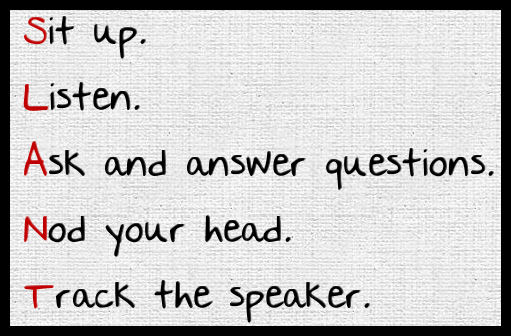
Lemov, D (2010). Teach like a champion: 49 
techniques that put students on the path to 
college. San Francisco: Jossey-Bass. (p. 109)

For example, when I have a student that isn’t on task, I sometimes say,  “If you don’t get on task, I am going to have to start requiring you to stay after school to make up time.” Lemov points out that, by stating it this way, I am assuming that the student will not stay on task. The solution is to say “Show me your best SLANT” and walk away “as if you couldn’t imagine a world in which (the student) wouldn’t do it” (p. 206). Of course, you may have to go back a couple of times to make sure that the student knows exactly what is expected, but it tells the student EXACTLY what you want him or her to do.

Imagine what it would be like if you started this at the beginning of the year? Off-task behavior would still be there, of course, but I bet it would be much easier to get the whole class back on track if you reacted positively by stating high expectations and standards. The entire book is like that. I kept on having “aha” moments as I worked through it. If are looking for a book that will improve your classroom management almost instantaneously, this is definitely a book to check out!

__________________________________________
Have you read a book this summer that really made you think? Leave me a comment because I’d love to check it out!

Philly "Phirsts"

Okay… I know that was a bad joke, but it made me giggle.

My district sent me to the ISTE (International Society for Technology in Education) Conference in Philadelphia. I was one of the lucky ones that got chosen. I was very excited to go. What I didn’t realize at the time that I was chosen is the fact that this trip would change my perceptions of so many things.

First off, Philadelphia is an awe-inspiring city. I didn’t realize how much history and diversity is packed in the small area where we were. We stayed at the DoubleTree on Broad Street. It is a gorgeous facility with a lobby that is great for people watching and hanging out. The best thing about it is that it was within walking distance of so much. I took advantage of it as much as I could.

Here are some of my firsts in Philadelphia:

I had my first Philly Cheesesteak at Spatoro’s in Reading Terminal Market. Let me tell you, the experience was definitely an interesting one. I waited in line for 45 minutes for the steaky-cheesy-oniony-peppery deliciousnes. Believe me, it was worth the wait. I now have a baseline for what a good Cheesesteak tastes like.

The buildings had murals on them!

I had my first ride in a taxi. It may sound corny, but it was something that I’ve always wanted to do. Luckily, I was with a very city-savvy young lady who made sure I didn’t die (thanks, Tracy).

I walked around a big city by myself. Previously, I wouldn’t be caught dead by myself in a place the size of Philadelphia. Here is the back story: My travel companions didn’t want to go to a gift shop that I wanted to enter. Instead of just passing it by, I told them that they could go ahead without me. It was a phenomenal feeling not having the pure anxiety that I used to have when walking alone. By the end of the trip, I was completely comfortable with being on my own.

Broad Street

I talked to people I didn’t know at all. In fact, I made first contact. Usually I sit back, observing everyone, thinking things in my head that I want to say aloud, and keeping silent. I pushed myself out there and struck up conversations with complete strangers. I decided that this ISTE conference would be one where I focused on my networking skills. It was very enriching. I think I get why people do it now. I am still not 100% comfortable with it, but I’m closer.

I took my alone time when I needed it. I am not good at taking myself out of a situation or a group because I don’t want people to think that I am not social. I’ve come to realize that I need my solitude in order to process. If I don’t get this, I go into a sort of a panic mode. By giving myself permission to go be by myself without feeling guilty, I was able to avoid some of the troubles that I usually have when dealing with large groups. It also helped that the great group of people I am with didn’t take it personally when I didn’t hang out with them.

Overall, the ISTE conference really enriched my life, both personally and professionally. I am so very thankful for the opportunity. I think I am going to have to figure out how I can attend next year’s conference in San Diego!

8 Big Ideas

I was recently turned on to this post by Scott McLeod (thanks to Twitter). Mr. McLeod writes about the GenYes Blog’s post about the 8 Big Ideas of the Constructionist Learning Lab. As I was perusing the “8 Big Ideas”, I started thinking about what goes on in my classroom. The ideas outlined seem like no-brainers, but I had to ask myself if I followed the concepts presented. After all, part of being a life-long learning is reflection, correct? The process was very eye-opening to me.

I realized that I still need to work hard on learning by doing. Trying to figure out how to make reading and writing a hands on activity is something that I struggle with. One of the ways that I am going to try to address this is by having my students be more hand on with their learning. I am going to go over the standard with them (thank you, Common Core Standards, for allowing me to do this without my brain exploding) and then ask THEM what they need to know in order to master the standard. I know that it will make planning more extensive, but the benefits will greatly outweigh the costs.

This segues perfectly into the next idea that struck me as pertinent: learning to learn. By giving my students more control over their learning, I will be giving them skills that will help them for the rest of their lives. Maybe it will encourage them to take the next step and the next and eventually not be so reliant upon other people to give them information. I also know that it is going to be a long process to get my students where they need to be. Many of them will be frustrated and challenged more than they’ve been challenged before. However, once they get started, they will enjoy it.

Hard fun is the third concept that stood out to me. Once they get used to the difficulty of guiding their own learning, they will start to see the fun in it. When I think of the classrooms of teachers that I admire, I see the students working hard, but having fun. The teachers in those classrooms take a challenging, abstract idea and make it the students’ responsibility to make it concrete. They guide the students, of course, and give them the help that they need when they get stuck; they also allow the students to fail over and over again in search of the solution. The thing is, the students love it. I like to think that I give my students some opportunities like this. I also know that I could do so much better at providing these sorts of things for my students.

Big idea #5, taking time, is one that worries me the most. I know that I can give my students unplanned time in the classroom. In fact, I do it often. When I say unplanned, I don’t mean letting the students do whatever they want. I mean that they have a task to complete in a certain amount of time, but how they get there is up to them. Unfortunately, my ability to give my kiddos time to learn how to manage it is limited by the requirements of the district. In this time of benchmarking, testing, assessing the assessments, and high stakes testing, the timeline of my classroom is determined by my administrators. Instead of being allowed to go more in-depth with what my students are learning, I have to fit 20 performance objectives into four-week intervals. I have to figure out a way to help my students get to where they need to be while still passing the “formative” pencil-and-paper tests required by the district. Maybe giving them the skills to learn on their own will help.

This is only the beginning of my musings on this topic. I know that I will have many more epiphanies as my brain chews on these concepts.